
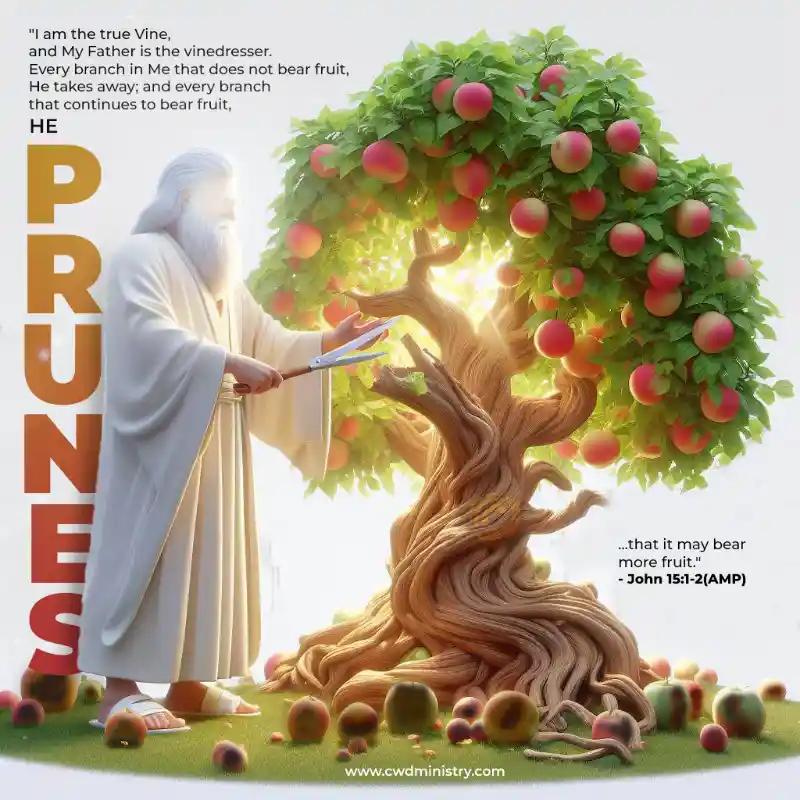
Pruning is a horticultural practice that involves selectively removing certain parts of a vine or plants, such as branches, shoots, or buds. This process is performed to achieve specific objectives related to the vine’s health, growth, and productivity.
John 15:1-2 [AMP]
1 “I am the true Vine, and My Father is the vinedresser.
2 Every branch in Me that does not bear fruit, He takes away; and every branch that continues to bear fruit, He [repeatedly] prunes, so that it will bear more fruit [even richer and finer fruit].
Jesus spoke about pruning, but many may not fully understand the process. Pruning is not the same as fertilizing or adding more nutrients to the vine; it specifically focuses on cutting off sections that may hinder the growth, development, progress, focus, and movement of such a vine. In our lives, certain environments, friends, work, and pursuits may hinder our growth toward fulfilling God’s purpose for us. Candy may seem sweet and enjoyable for a child, but the parent knows that it adds no value to the growth and development of such a child.
As sweet as the pruning verse may be, the pruning process might be the most painful for such branches on the vine, not realizing why, despite being so tender, their lovely cherished new glowing leaves are being cut off. It’s uncertain whether the vinedresser hates or cares for the branches [believers]. The process of pruning is advantageous in saving the nutrients of the vine or branches for its growth. The immature stage of having a lot of leaves or branches [glorifications, achievements] may lead to hindrances in growth and sustainability. The vinedresser will always use this process to realize his beautiful vine structure with well-balanced, well-groomed, and well-nurtured branches.
Here are some reasons for pruning in God’s garden:
- Shape and Structure: Pruning helps shape the branches (believers) and maintain a desired structure (purpose). This is especially important for fruit trees (fruitful believers) and ornamental vines (radiating believers). Proper pruning can encourage a well-balanced canopy and prevent the overcrowding of branches (different beliefs and doctrines).
- Disease and Pest Control: Removing infected or infested branches (carnal friends, pursuits, and environment) can help control the spread of diseases (worldliness) and pests (demons). Pruning allows for better air circulation (spiritual atmosphere) and sunlight penetration (heavenly endowment), reducing conditions favorable for the development of pathogens and pests (bitterness and demons).
- Fruit Production: Pruning is important for fruit-bearing branches (God’s faithful servants) to improve the quality and quantity of fruits (harvest of souls). By removing excess leaves (distractions), the branches can direct more energy (spiritual strength and focus) into producing larger and healthier fruits (anointed believers).
- Deadwood Removal: Cutting away dead or damaged branches (carnal believers, distractions, pursuits) helps maintain the vine’s health (oneness and unity). Deadwood (worldly norms and carnal cultures) can be a potential source of diseases, and its removal encourages the branches (believers) to allocate (spiritual) resources to living, productive parts.
- Renewal: Pruning stimulates new growth (new Christian experience) and can rejuvenate (inspire, restore) older branches (relaxing, tired, weary believers). By removing unproductive wood (distractions), the vine redirects resources to instigate or initiate more growth.
- Training Young Shoots: Pruning is used to shape and train young shoots (young believers) to grow (to seek God) in a specific way. This is common in vineyards (fellowships).
- Size Control: Pruning helps control the size (spiritual enlightenment) of the branches, especially in confined spaces (crowded and diverse spiritual knowledge). This is important in urban agriculture (mega-churches), where space (true gospel knowledge) may be limited.
No matter how challenging our journey of pruning may be, always remember that the vinedresser would never intentionally cut off a fruitful branch (believer). All his intentions are for the betterment of the vine to produce more fruits. Learn to avoid infections and learn to avoid pests.
God bless you.